
Is Software Engineering Really Dead? What AI CEOs Get Wrong (And What It Means for Your Product)
Is Software Engineering Really Dead? What AI CEOs Get Wrong (And What It Means for Your Product)
The headlines are dramatic. AI company executives are publicly warning that traditional software engineering could become obsolete within a year. Tech founders are advising developers to consider alternative careers. The message is clear: AI will write all the code, and human engineers are on borrowed time.
But here's what nobody making these claims wants to talk about: if AI can truly replace software engineers, why is every AI-built product we see riddled with bugs, security holes, and deployment failures?
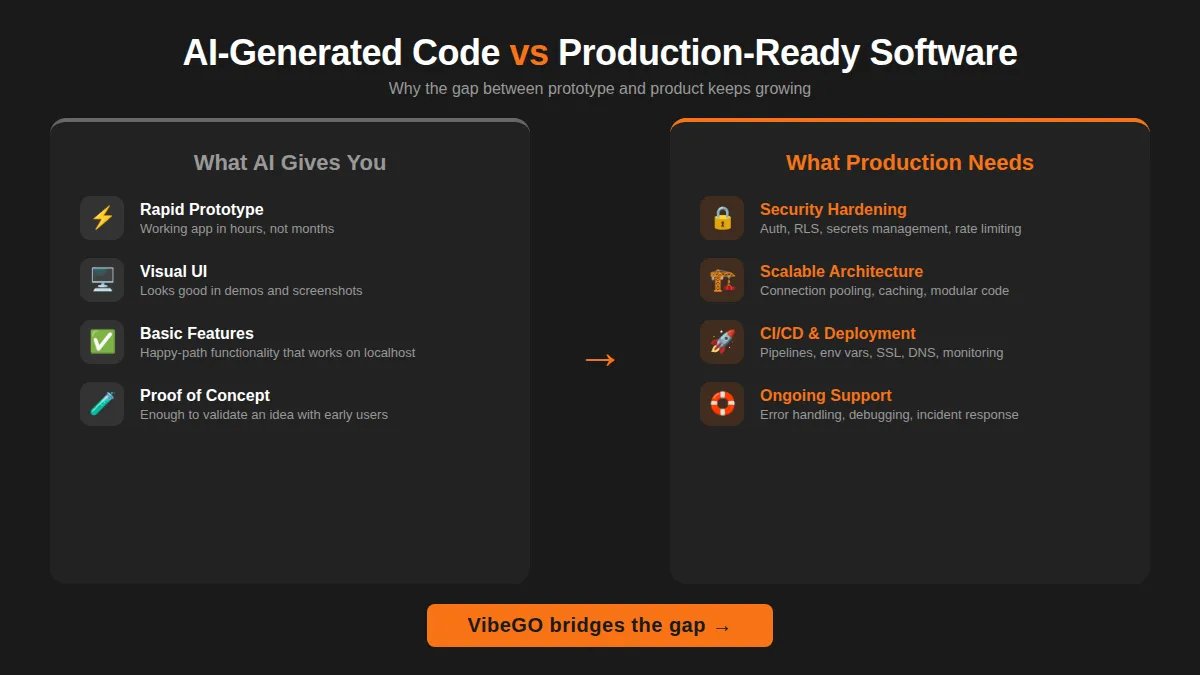
The Headline vs. The Reality
Let's be honest about what's actually happening. AI coding tools — Cursor, Claude Code, Lovable, Replit, Bolt — have genuinely changed how software gets built. Non-technical founders can now create working prototypes in hours instead of months. That's real. That's significant.
But there's a canyon-sized gap between "AI can generate code" and "AI can engineer software."
Code is just text that runs. Engineering is the discipline of making it run reliably, securely, at scale, and in production — day after day, under real-world conditions that no AI tool is currently designed to handle.
What AI Actually Does Well
Credit where it's due. AI coding tools excel at:
- Rapid prototyping — Going from idea to working UI in hours
- Boilerplate generation — CRUD operations, form handling, standard patterns
- Code translation — Converting between languages and frameworks
- Documentation — Explaining existing code and generating docs
- Learning acceleration — Helping non-developers understand and build software
These capabilities are genuinely transformative. They lower the barrier to entry and dramatically speed up the early stages of building a product.
What AI Consistently Gets Wrong
But the things AI struggles with are precisely the things that separate a prototype from a product:
Architecture That Scales
AI builds for the current prompt, not for the next 10,000 users. It doesn't think about database indexing, connection pooling, caching strategies, or how your authentication system will handle concurrent sessions. It gives you something that works right now — and collapses when reality hits.
Security That Actually Protects
AI routinely generates code with hardcoded API keys, wide-open database policies, missing rate limiting, and authentication that looks correct but has critical flaws. Security isn't a feature you bolt on — it's a mindset that needs to permeate every line of code. AI doesn't have that mindset.
Deployment That Doesn't Break
The number one complaint we hear from founders using AI tools: "It works on my machine but won't deploy." AI has no concept of CI/CD pipelines, environment variables, SSL certificates, DNS configuration, or the dozen invisible infrastructure decisions that keep a production application alive.
Debugging Under Pressure
When your app goes down at 2am and your users are complaining on Twitter, you need someone who can read logs, understand system architecture, trace a bug through multiple services, and fix it — fast. AI tools are brilliant at writing new code. They're remarkably poor at understanding why existing code is broken in a specific production environment.
The Real Future: Humans + AI
The executives making these "engineering is dead" claims are doing something specific: they're selling AI tools. Their incentive is to maximise the perceived capability of their products. That's not dishonest — it's marketing.
The actual future is more interesting and more practical:
- AI handles the 80% — The repetitive, well-defined, pattern-based work that follows established conventions
- Engineers handle the 20% — Architecture decisions, security reviews, production reliability, debugging, and the judgment calls that require understanding context beyond the current prompt
- The barrier to entry drops — More people can build software, which means more software gets built, which means more demand for the people who can make it production-ready
The developers who should be worried are those doing purely repetitive work that AI can fully automate. The developers who will thrive are those who understand systems, security, reliability, and deployment — the things AI can't do yet.
What This Means for Your Business
If you're a founder or business owner building with AI tools, here's the practical takeaway:
- Use AI for speed. Build your prototype, validate your idea, get to market fast. AI is extraordinary for this.
- Don't skip the engineering. Before you put customers on your product, get a professional review. Architecture, security, deployment — these aren't optional.
- Budget for production readiness. The AI-built prototype is maybe 30% of the work. The other 70% is making it reliable, secure, and scalable.
- Don't believe the hype uncritically. The people telling you engineering is dead are the same people selling the tools they say will replace engineers. Think about that.
Where VibeGO Fits
We exist precisely because of this gap. We work with founders and teams who've used AI to build something real — and now need it to actually work in production.
We don't replace the AI tools you used to build your product. We make sure what they built can survive contact with real users.
Software engineering isn't dead. It's just changed shape. And the people who understand both the AI tools and the engineering fundamentals are exactly who you need on your side.